
Online Slots vs Sports Betting in Kenya: Key Differences
Online slots and sports betting both carry a built-in house edge, so neither is a way to earn money. Slots are pure chance, decided by a random number generator; a sports bet is priced on a real match, where research can sharpen your decisions. Both are 18+ only in Kenya.
Betting Sites Kenyan Players Can Compare
Below are the betting sites we rank for Kenyan players. Many of them also run a casino lobby with slots: check the games on offer and the operator’s GRA licence before you deposit. You must be 18+.
 22bet

- 1xbet
 Betika
- Megapari


 Bet365

- Melbet


- Betway
- Betwinner
 Dafabet
- Mozzart bet
 MrPlay
- Sportaza
- Betsafe


































Online slots vs sports betting in Kenya is a choice between two different ways of paying for entertainment. A slot’s result comes from a random number generator (RNG) in a few seconds, and its return to player (RTP) is set by the game. A sports bet is priced on a real match, and the bookmaker’s margin sits inside the odds. Play either only with a licensed operator, and only if you are 18+.
In short:
- 🎰 Slots: pure chance, decided by an RNG; the game’s RTP tells you its long-run payback.
- ⚽ Sports betting: real events, priced as odds; research can improve your decisions but cannot remove the margin.
- ⏱️ Pace: a slot can settle hundreds of rounds an hour, while a sports bet usually waits for the final whistle.
- ⚖️ Same law: the Gambling Control Act, 2025 covers betting, gaming and casinos and has been in force since 26 August 2025.
- 🏛️ Same regulator: the Gambling Regulatory Authority (GRA), which took over from the BCLB in February 2026.
- 📱 Same payment rails: M-Pesa (Paybill), Airtel Money, bank transfer and debit card.
Online Slots vs Sports Betting: Side-by-Side Comparison
The table compares the two products on the points that decide how your money behaves. The last column shows which one comes out ahead on each point, from a player’s point of view.
| Criterion | Online slots | Sports betting | Who it favours |
|---|---|---|---|
| What decides the result | A random number generator; every spin is independent | A real match or event | Sports betting, if you enjoy analysis |
| Price you see before you play | The RTP, in the game’s help screen | The odds, on every bet slip | Sports betting: prices are visible per bet and can be compared |
| House advantage | 100% minus the RTP (4% on a 96% RTP game) | The margin in the odds (about 5% on a 1.90 / 1.90 market) | Close per shilling staked; depends on the game and the market |
| Does research help? | No | Yes, within limits | Sports betting |
| Pace | Seconds per round | Hours or days per settled bet; faster in-play | Sports betting, for slower spending |
| Swings | Set by the game’s volatility | Set by the odds you pick; long accumulators swing hardest | Depends on your choices |
| Session control | Needs a timer and a stop-loss | The fixture list paces you, unless you bet in-play | Sports betting |
| Typical bonus | Free spins, often with a wagering requirement | Free bets, often with the stake not returned | Neither: read the terms |
| Legal framework | Gambling Control Act, 2025; GRA licence | Gambling Control Act, 2025; GRA licence | Same |
| Minimum age | 18+ | 18+ | Same |
The pattern is clear. Sports betting gives you more information and, outside in-play markets, a slower rhythm. Slots offer simpler, faster entertainment with nothing to research. Neither changes the basic maths, which favours the operator over time.
RTP vs Bookmaker Margin: How Each One Pays the House
Every gambling product pays back less than it takes in. The difference is how the operator earns, and slots and sportsbooks show it in different places.
Slots: return to player (RTP)
RTP is the share of all money staked on a game that it is designed to pay back over a very long run. A slot with a 96% RTP returns, in theory, KSh 96 for every KSh 100 wagered across millions of spins, which leaves a house edge of 4%. In a single session the result can be far above or below that figure: RTP describes the game’s long-run maths, not what you will get back tonight. The figure is published in the game’s help or paytable screen, and some providers supply the same title in more than one RTP version, so check it at the casino where you play.
Sports betting: the bookmaker’s margin
A bookmaker builds its margin into the odds. Convert each price to an implied probability by dividing 1 by the odds, then add the results. On a fair book they would total exactly 100%; in practice they total more, and the excess is the margin. The examples below are illustrative.
| Example market | Odds | Implied probabilities | Total | Margin |
|---|---|---|---|---|
| Two-way, fair | 2.00 / 2.00 | 50% + 50% | 100% | 0% |
| Two-way | 1.90 / 1.90 | 52.6% + 52.6% | 105.3% | About 5% |
| Three-way (1X2) | 2.40 / 3.20 / 3.10 | 41.7% + 31.3% + 32.3% | 105.2% | About 5% |
A 5% margin means that, on average, a bettor gets back roughly KSh 95 for every KSh 100 staked on that market. Margins differ between bookmakers and markets, which is why comparing prices before you bet is one of the few habits that genuinely improves your returns.
Per shilling staked, a 96% RTP slot and a 5% margin market cost about the same. The real difference lies in how many shillings you put through each one in an hour, which is the next point.
Cost per Hour: Why Pace Matters More Than the Percentage
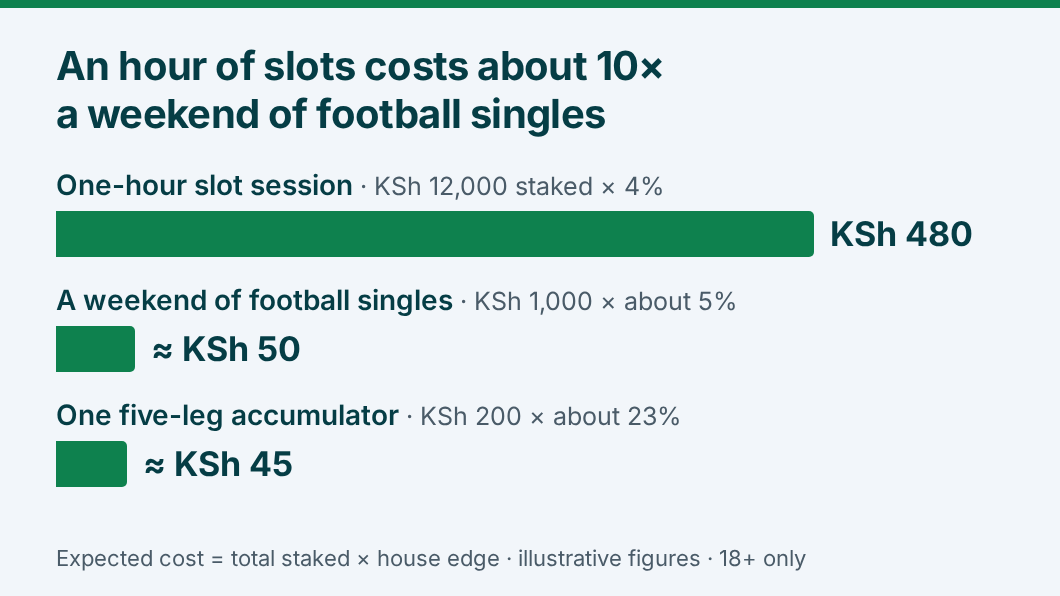
The house edge is charged on every shilling you stake, not on your deposit. A fast game recycles the same money many times, so its cost per hour grows with the speed of play. The example uses illustrative figures, not a specific game or bookmaker.
| Scenario | Stake per round | Rounds | Total staked | House edge | Expected cost |
|---|---|---|---|---|---|
| One-hour slot session | KSh 20 | 600 spins (10 a minute) | KSh 12,000 | 4% (96% RTP) | KSh 480 |
| A weekend of football singles | KSh 200 | 5 bets | KSh 1,000 | About 5% | About KSh 50 |
| One five-leg accumulator | KSh 200 | 1 slip | KSh 200 | About 23% | About KSh 45 |
The slot session costs about ten times more than the weekend of singles, even though its house edge is lower. It is not the percentage that empties a budget, it is the volume. The same logic applies to sports betting: twenty quick in-play bets in an evening turn a slow product into a fast one.
Accumulators show the other side of the maths. Each leg carries its own margin, and the margins multiply. If every leg gives back about 95% in theory, five legs give back 0.95 × 0.95 × 0.95 × 0.95 × 0.95, or about 77%. That is a steeper house edge than the 96% RTP slot in our example, packed into a single slip.
Pro tip: Work out your cost per hour before you play: stake per round × rounds per hour × house edge. If the figure is more than you would pay for an evening out, lower the stake, slow the pace or stop.
Chance vs Research: What You Can and Cannot Influence
On a slot, every spin is decided by the RNG at the moment you press the button, and each spin is independent of the last. A machine is never “due” to pay, a long dry spell does not make a win more likely, and no pattern, time of day or stake sequence changes the odds. The only decisions that matter are how much you stake per spin, which game you choose (its RTP and volatility) and when you stop.
A sports bet gives you more to work with. Team news, injuries, fixture congestion, form and the weather can all shift the true chance of a result, and you can compare the price on offer with your own estimate. That is why preparation has value in betting and none on a slot.
The limit matters just as much. Research improves your decisions; it does not remove the bookmaker’s margin, and short-run results in football are noisy. Most bettors still lose over time. If you enjoy analysis, sports betting gives that interest something to work on. If you want entertainment with no homework, slots fit that preference, as long as you accept that the outcome is entirely out of your hands.
Pro tip: Before each bet, write down why you think the price is wrong. If you cannot name a reason, such as a missing striker or a fixture pile-up, you are relying on luck, just as you would on a slot.
Volatility: How Wins and Losses Arrive
Two products with the same house edge can feel completely different, because the wins arrive in different patterns. That pattern is called volatility.
| Choice | How results usually arrive | Best treated as |
|---|---|---|
| Low-volatility slot | Frequent small wins that move the balance slowly | A long, low-stake session |
| High-volatility slot | Long runs without a win, with rare large ones | A budget you accept losing for a shot at a big hit |
| Singles at short odds (e.g. 1.40) | Win often, pay little | Steady, low-drama betting |
| Singles at long odds (e.g. 5.00) | Lose most of the time, pay well when they land | Small stakes with patience |
| Long accumulators | Rarely land; large payout when they do | A small “lottery” stake only |
Slot volatility is set by the game, and providers often describe it as low, medium or high in the game information. In sports betting you set it yourself through the odds you choose and the number of legs on the slip. A five-leg accumulator at 1.80 a leg pays about KSh 3,779 on a KSh 200 stake, but even if each pick has a 55% chance, all five land only about 5% of the time. For roughly 19 slips in 20, the stake is lost.
Match the volatility to your budget. A small session budget on a high-volatility slot, or on long accumulators, usually ends quickly; the same money on low-volatility games or short-odds singles lasts longer, with smaller wins along the way.
Free Spins vs Free Bets: Comparing the Bonuses
Casinos tend to promote slots with free spins, and bookmakers tend to promote sports betting with free bets. Both can add value, but the terms decide how much.
Free spins
Free spins let you play a set number of rounds on a named slot at a fixed stake. Winnings from them are often paid as bonus money with a wagering requirement attached. For example, KSh 300 won from free spins with a 30x requirement means staking KSh 9,000 before you can withdraw, and at a 4% house edge that wagering costs about KSh 360 in theory, more than the winnings themselves.
Free bets
A free bet gives you a stake to place on a sports market. On many free bets the stake itself is not returned with the winnings. A KSh 500 free bet at odds of 3.00 then pays KSh 1,000, not the KSh 1,500 you would get with a cash stake, so a free bet is worth less than its face value. Some betting bonuses also carry a rollover, a minimum odds rule or both.
Whichever you claim, read the wagering, minimum odds, game restrictions and expiry date first. Our guides to casino bonuses and free bets in Kenya explain the terms in more detail.
Same Law, Same Regulator: Licensing for Slots and Sports Betting
Slots and sports betting answer to one law in Kenya. The Gambling Control Act, 2025 regulates betting, lotteries, gaming and casinos under a single framework, and one authority licenses the people and companies that offer them.
| Date | Milestone | What it means for you |
|---|---|---|
| 1966 | Betting, Lotteries and Gaming Act (Cap. 131) | The old framework, now repealed |
| 7 August 2025 | Gambling Control Act, 2025 receives assent | The new law is signed |
| 26 August 2025 | The Act comes into force | Cap. 131 is repealed |
| February 2026 | Formal transfer from the BCLB to the GRA completed | The GRA licence is the one to check |
The Gambling Regulatory Authority (GRA) has a legal mandate to receive, investigate and arbitrate complaints about lotteries, gaming, betting and casinos. That covers a withheld slot payout as much as a wrongly settled bet, but only if the operator is licensed: against an unlicensed site there is no Kenyan regulator to turn to. The minimum age is 18+ for every form of gambling, and licensed operators verify it at registration or before a withdrawal.
If a licensed operator refuses to pay or settles a bet against the official result, raise it with the operator first and keep the bet IDs, game round references, screenshots and M-Pesa messages. If the dispute is not resolved, the GRA is the body to approach.
Paying for Slots and Bets: M-Pesa, Airtel Money and Cards
The same payment rails fund both products, often through one account balance at operators that run a sportsbook and a casino side by side. The methods used in Kenya are M-Pesa (Paybill), Airtel Money, bank transfer and debit card. Credit cards are not on that list: under the Gambling Control Act, 2025, a licensed site cannot take slot spins or bets paid with one.
| Method | How you pay | Watch out for |
|---|---|---|
| M-Pesa (Paybill) | Paybill number plus account reference, or an STK push prompt | A wrong account reference sends money to the wrong place |
| Airtel Money | Pay bill from the Airtel Money menu or app | Fewer sites support it than M-Pesa |
| Bank transfer | From your bank account to the operator’s | Slower than mobile money |
| Debit card | Visa or Mastercard at the cashier | Your bank may decline gambling payments |
Two habits help with either product. Withdraw to the same number or account you deposited from, because a mismatch is a common reason for extra checks. And move your entertainment budget across in one transfer rather than paying from your main balance round by round: one transfer is easy to track, ten small ones are not. Our guide to payment methods compares deposit and withdrawal steps in more detail.
A KSh Budget Plan for Slots and Sports Betting
Whichever you choose, decide the money before you play. The structure below uses a monthly entertainment budget of KSh 4,000; scale it to an amount you can afford to lose without touching rent, school fees or savings.
| Budget layer | Rule | Example |
|---|---|---|
| Monthly budget | Money you can lose without hardship | KSh 4,000 |
| Weekly cap | Monthly budget divided by four | KSh 1,000 |
| Sports bet stake | 2–5% of the monthly budget per bet | KSh 80–200 |
| Slot session | One session budget and a timer | KSh 500 and 30 minutes |
| Slot stake | Small enough for at least 50 spins per session budget | KSh 10 or less |
| Daily stop-loss | Stop for the day once it is reached | KSh 500 |
Track each product in the way that suits it. A sports bet leaves a clear record of stake, selection, odds and result, often settled hours later, so a simple list soon shows which markets work for you. Slots produce hundreds of small transactions in one sitting, so note your balance at the start and end of each session and how long you played. Over a month, those figures tell you more than any single big win or loss.
- 📅 Review the month on the same date, using your account’s transaction history.
- 📉 If your budget falls by half, halve your stakes as well. Never raise them to win the money back.
- 💰 Treat money you withdraw as spent on something else, not as a fresh bankroll.
Responsible Play: Tools and Warning Signs for Both
Licensed operators tie each account to a verified identity and mobile money number, and that is what makes the control tools work. Set them while you are calm, before the first spin or bet.
- Deposit limits: a daily, weekly or monthly cap on what can go in.
- Session reminders, where offered: an alert after a set time, especially useful on slots, where an hour can pass in what feels like minutes.
- Time-outs: a short break, from a day to a few weeks, that locks the account.
- Self-exclusion: a longer block for when gambling has stopped being entertainment.
The warning signs are the same for slots and bets: borrowing to play, hiding stakes from family, playing to escape stress, chasing losses and feeling that the next win will fix things. Any one of them is reason enough to set a limit today. Our page on betting help in Kenya explains self-exclusion and where to turn for support.
Pro tip: Lowering a limit usually takes effect straight away, while raising one normally involves a waiting period. Use that on purpose: set a cautious limit now, and any later urge to raise it has to survive the cooling-off period.
Slots or Sports Betting: Which Should You Choose?
No product beats the house, so the honest question is which one fits the way you like to spend your entertainment budget.
Choose sports betting if…
- you follow football or other sports and enjoy reading team news and comparing odds;
- you want a slower rhythm, with a few decisions a week rather than hundreds an hour;
- you are happy to keep stakes flat and stick mostly to singles.
Choose slots if…
- you want simple, quick entertainment with nothing to research;
- you can hold to a session budget and a timer, because the pace is fast;
- you check the game’s RTP and volatility first and pick a stake that gives you a long session.
Choose neither if…
- you are playing to pay a bill, clear a debt or win back losses;
- you are under 18, or the money is not money you can afford to lose.
If you go for sports betting, our guide to sports betting in Kenya compares licensed bookmakers. If you prefer slots, see how slot machines work and our overview of online casinos in Kenya.
FAQ's: Frequently Asked Questions
Yes, with a licensed operator. Slots and sports betting fall under the same law, the Gambling Control Act, 2025, which regulates betting, lotteries, gaming and casinos. Play only at a site licensed by the Gambling Regulatory Authority (GRA), and only if you are 18+.
Per shilling staked they can be close: a slot with a 96% RTP keeps about 4% over the long run, and a market with a 5% margin keeps about the same. What usually decides your cost is pace. Slots settle hundreds of rounds an hour, so the same edge is charged on far more money, and long accumulators multiply the bookmaker’s margin.
No. Each spin is decided by a random number generator and is independent of the last, so no pattern, timing or staking system changes the result. Your only real choices are the game, the stake per spin and when you stop.
Research, comparing odds and stake control can improve your decisions, which is not possible on a slot. The bookmaker’s margin still means most bettors lose over time, and short-run results are just as uncertain.
18+ for every form of gambling. Licensed operators check your identity at registration or before a withdrawal, so an account opened by someone under 18 should never reach a payout.